
Exercise for Menopause: What Actually Protects Your Body for the Next 30 Years
The exercise advice that worked in your thirties can work against you now. Long cardio sessions that once felt productive may leave you more depleted. Meanwhile the training that matters most for the decades ahead, the kind that protects your bones and muscle, is the part most women were never told to prioritize.
This page breaks down each type of movement by what it actually does for a menopausal body across three things that matter: your hormonal load, chiefly cortisol and insulin sensitivity, and the two outcomes that determine how independent you'll be at 75, bone density and muscle mass.
Here's the frame before we get into specifics. Exercise doesn't reverse estrogen decline. Anyone selling you a workout that "balances your hormones" is overstating it. What movement genuinely does is manage your cortisol load, improve how your body handles blood sugar, and directly build the bone and muscle that falling estrogen is actively stripping away. That last point is the whole game, and it's why the priorities shift now.
Why menopause changes the exercise equation
Estrogen protects bone and supports muscle. As it declines, both erode faster than they did before. Women can lose a significant share of bone density in the years right around menopause, and muscle loss accelerates at the same time. This isn't a cosmetic concern. Bone density determines fracture risk, and muscle mass determines whether you can carry groceries, get off the floor, and stay steady on your feet in your seventies and eighties.
At the same time, lower estrogen makes your body less efficient with blood sugar, and a higher cortisol load makes it easier to store fat around the middle. So the exercise that helps now is exercise that does double duty: builds bone and muscle while keeping cortisol and insulin in check. The types below deliver on that to very different degrees.
Functional strength training
Functional strength training uses compound, real-world movement patterns: squats, hinges, carries, pushing, pulling. Movements that mirror how you actually use your body.
What it does for bone and muscle: This is the highest-value category for menopause, full stop. Loading your skeleton through resistance signals bone to maintain and build density, which directly counters the post-menopause loss. It builds and preserves the muscle that estrogen decline is taking, and because the patterns are functional, that strength transfers to daily life, which is what stability and independence actually depend on.
What it does hormonally: Strength work improves insulin sensitivity, helping your body handle blood sugar better. Done in reasonable sessions, it builds muscle without the sustained cortisol spike of long endurance work. It's the rare category with no real hormonal downside for most women.
The tradeoff: Form matters, and the learning curve is real. Bad technique under load risks injury, so this is the modality most worth learning properly, whether through a coach, a program, or careful progression. That's a reason to start deliberately, not a reason to skip it.
Weightlifting
Weightlifting overlaps with functional strength but leans toward heavier loads and structured progression: lifting meaningful weight for lower repetitions and adding load over time.
What it does for bone and muscle: Heavier loading is one of the strongest known stimuli for bone density. Progressive resistance, adding weight as you get stronger, drives both bone and muscle gains more aggressively than lighter work. For a woman focused on fracture prevention and long-term strength, this is as effective as it gets.
What it does hormonally: Same profile as functional strength. It improves insulin sensitivity and builds muscle without the prolonged cortisol load of endurance training. Short, intense strength sessions raise cortisol briefly, but it settles quickly and doesn't create the chronic elevation that sustained cardio can.
The tradeoff: The intimidation factor is the main barrier, not the risk. Many women worry heavy lifting is unsafe or will make them bulky. Neither holds up. Building significant size is genuinely hard and requires deliberate effort most women never approach. The real requirement is learning proper form and progressing gradually, same as functional training.
Cardio
Cardio covers everything from walking to running to cycling to classes. The category is broad, and the menopause answer depends heavily on intensity and duration.
What it does for bone and muscle: This is where cardio underdelivers for menopause. Most cardio, especially non-impact forms like cycling and swimming, does little for bone density. It doesn't build muscle and, at high volumes, can eat into it. Walking and other weight-bearing cardio offer modest bone benefit, but nowhere near what loading provides.
What it does hormonally: Here's the nuance. Moderate cardio, especially walking, is excellent for cortisol. It lowers stress, supports mood, and helps blood sugar. But long, intense endurance sessions do the opposite: they raise cortisol during and after, and in a menopausal body already running high, that sustained elevation can backfire, leaving you more depleted and making midsection fat harder to shift.
The tradeoff: Cardio isn't the enemy, but it shouldn't be your main event anymore. The mistake is making long cardio the centerpiece while neglecting strength. Keep it, favor moderate and weight-bearing forms, and let it support your training rather than dominate it. If you love hard cardio and recover well, it can stay, just not at the expense of loading your bones and muscles.
Yoga
Yoga combines movement, balance, flexibility, and breath. Its value in menopause comes from a different direction than strength or cardio.
What it does for bone and muscle: Modest but real. Weight-bearing poses that hold your body against gravity offer some bone benefit, and holding positions builds a degree of strength. It won't match dedicated resistance training, but it isn't nothing, and the balance component is genuinely protective. Balance is what prevents the falls that turn low bone density into a broken hip.
What it does hormonally: This is yoga's strongest axis. It has direct evidence for lowering stress, reducing cortisol, and improving sleep in menopausal women, because it pairs movement with the nervous-system regulation of breath. For the cortisol side of the menopause picture, few things work better.
The tradeoff: It's a complement, not a foundation. Relying on yoga alone leaves the bone and muscle gap largely unaddressed. Paired with strength work, it covers what strength training doesn't: flexibility, balance, and stress regulation.
Pilates
Pilates focuses on core strength, controlled movement, stability, and alignment.
What it does for bone and muscle: Its real contribution is core strength and stability, which underpin balance, posture, and safe movement in everything else you do. A strong, stable core is part of what keeps you upright and injury-free as you age. It builds some overall strength, though most mat-based Pilates uses light resistance, so it's not a primary driver of the bone-loading or major muscle building menopause calls for.
What it does hormonally: Similar to yoga on the calming side, though usually less breath-and-stress focused. The controlled pace keeps cortisol low, and better insulin sensitivity follows from being active, but Pilates isn't where the big hormonal or metabolic shifts come from.
The tradeoff: Excellent for stability, core, and injury prevention, and it makes your heavier training safer and more effective. But like yoga, it works best alongside loading, not instead of it.
Stretching and mobility
Stretching and mobility work keep your joints and muscles moving through their full range.
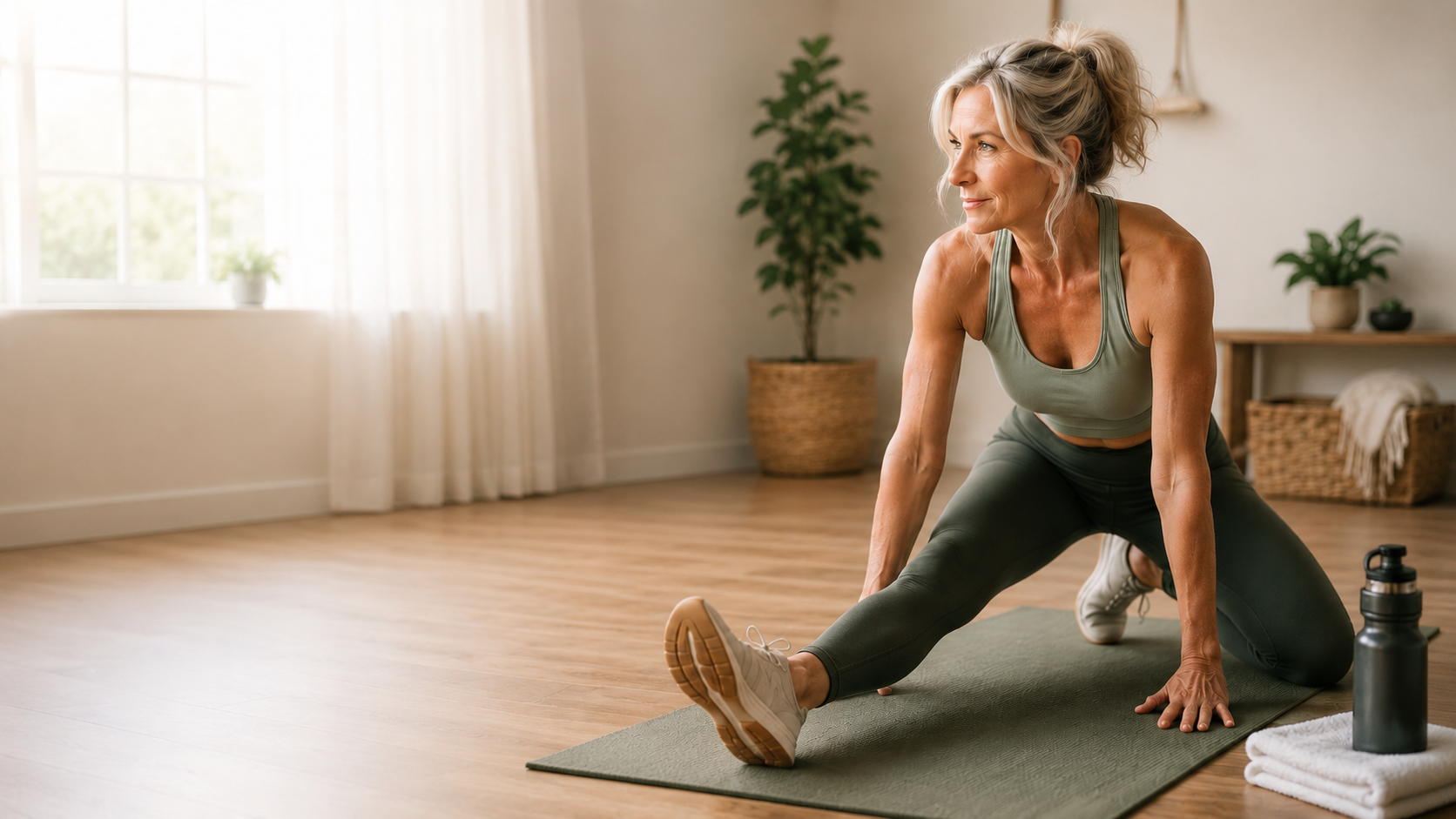
What it does for bone and muscle: Directly, little. It doesn't build bone or meaningful muscle. Its value is indirect and real: good mobility lets you strength train with proper form, reduces injury risk, and preserves the range of motion that keeps everyday movement easy as you age.
What it does hormonally: Minimal direct effect. Gentle stretching can calm the nervous system slightly, but this isn't a cortisol or metabolic tool.
The tradeoff: Never the main event, always worth including. Think of it as the maintenance that keeps everything else working, not a workout in its own right.
How to prioritize when you can't do everything
If you take one thing from this page: strength training is the non-negotiable. Functional strength and progressive weightlifting are the only categories that directly counter the bone and muscle loss that determines your independence decades from now. If your week only has room for one type of training, make it loading your body against resistance.
From there, layer intelligently. Add weight-bearing or moderate cardio for heart health and cortisol management, favoring walking over long grinding sessions. Add yoga or Pilates for balance, core stability, and stress regulation, which protect you from the falls that low bone density makes dangerous. Use stretching to keep it all moving safely. A realistic week might be two to three strength sessions, regular walking, and one or two yoga or Pilates sessions. Not perfect. Sustainable.
The cortisol thread runs through all of this, and it connects to something bigger. How you manage stress shapes how your body responds to training, how you recover, and how well you sleep. That side of the picture, the nervous system, cortisol rhythm, and the tools that regulate them, is worth understanding in its own right.
Common questions about menopause and exercise
Is it too late to start strength training after menopause?
No. Women who begin resistance training in their fifties, sixties, and beyond still build muscle and improve bone density. The body responds to loading at any age. The best time to start was years ago; the second best is now.
Will lifting heavy weights make me bulky?
No. Building significant muscle size is difficult and requires deliberate, sustained effort most women never approach. What strength training actually gives you is a leaner, stronger, more capable body and the bone density that prevents fractures later.
How much exercise do I actually need in menopause?
A practical target is two to three strength sessions a week, regular walking, and one or two sessions of yoga or Pilates. Consistency over years matters far more than any perfect weekly plan.
Why am I gaining weight around my middle even though I exercise?
Midsection weight gain in menopause is driven by falling estrogen, reduced insulin sensitivity, and a higher cortisol load, not just calories burned. Long intense cardio can make it worse by keeping cortisol elevated. Strength training and stress management usually do more for this than adding more cardio.
Can exercise replace hormone therapy or medication?
No, and this page isn't suggesting it. Exercise is a powerful tool for managing the menopause transition, but decisions about hormone therapy or medication belong with your doctor. This content is educational and isn't a substitute for medical advice.
More About Movement/Exercise

Strength Training for Menopause: A Starting Framework
If you've accepted that strength training is the thing that protects your bones, muscle, and independence after menopause, the next question is the one nobody answers clearly: What do you actually do? How many days, how many reps, how heavy, and how do you get started...
coaching packages
Work With Me...
You've been told your labs are normal. You've been told to lose weight, sleep more, stress less, and then sent home. You know something is off, and you're tired of explaining it to people who don't listen.
I've been where you are. I know you're not crazy.
What I teach isn't another overhaul that falls apart by week three. It's small, sustainable changes you can start the day you learn them, built around the four things your body actually runs on: how you nourish it, how you move, how you rest, and how you handle stress. And you won't do it alone. You'll have a private community of women walking the same road right beside you.
Here are three ways to work together. Pick the one that fits where you are right now.
Self Study
For the woman who wants to start today, at her own pace. A step-by-step program you move through on your own schedule, using the same simple changes I made myself. Everything is designed to be doable from day one. No overwhelm, no all-or-nothing rules. Start whenever you're ready.
Group Consulting
Learn alongside a small group of women who get it. You get a live group session (60 minutes) plus access to my private Facebook community, where you can ask questions, share wins, and finally be heard between calls. It's real support and real accountability, without the one-on-one price.
One-on-One Consulting
My most personal option. We work together directly to build a plan around your body, your history, and your life. You get my full attention and a woman in your corner who has actually been through it, not a script. This is for you if you're done piecing it together alone and want a real guide.