

If you’ve accepted that strength training is the thing that protects your bones, muscle, and independence after menopause, the next question is the one nobody answers clearly: What do you actually do? How many days, how many reps, how heavy, and how do you get started without hurting yourself. This page is the framework.
I’m Alicia Hughes, a Certified Women’s Hormonal Health Coach through HerAcademia. What follows is how to begin strength training in menopause and progress it sensibly, from your first bodyweight session to genuinely heavy lifting. It’s a map, not a prescription, and the most important rule is the one most beginners skip: earn the load before you chase it.
Start With The Movement Patterns, Not The Weight
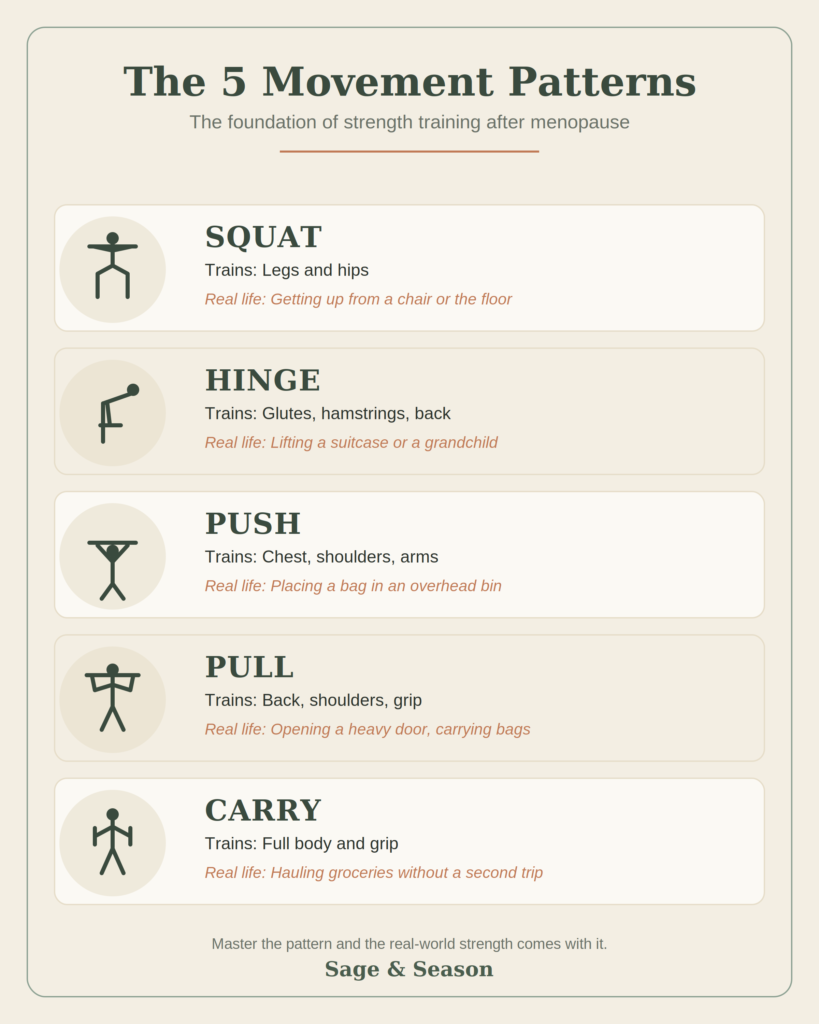
Strength training in menopause is built on a handful of fundamental movement patterns, not on machines or isolation exercises. Master these and you’ve covered almost everything your body needs:
A squat pattern, lowering and standing back up, which trains your legs and hips. A hinge pattern, bending at the hips with a flat back, which trains the whole posterior chain and is the foundation of a deadlift. A push, moving weight away from you, overhead or horizontal. A pull, drawing weight toward you, like a row. And a carry, holding something heavy and walking, which builds full-body and grip strength that transfers directly to daily life.
These patterns matter more than any specific exercise because they’re what you actually do when you lift a grandchild, put a suitcase in an overhead bin, or get off the floor. Train the pattern, and the real-world capability comes with it.
The Starting Framework: Weeks 1-4
Your first month has one job, and it isn’t building muscle. It’s teaching your body the patterns with good form, at a load light enough that you can focus entirely on technique. This is the familiarization phase, and even the research protocols that push heavy weight build it in first.
Start with two sessions a week, on non-consecutive days. Each session, work through the patterns: a squat, a hinge, a push, a pull. Use bodyweight, light dumbbells, or resistance bands. Aim for 2 to 3 sets of 8 to 12 repetitions per movement. The weight should feel manageable, and the last rep of each set should feel like you had 2 or 3 more in the tank, not like a struggle.
The goal this month is to finish every session thinking you could have done more. That restraint is what lets you progress without injury. Resist the urge to load up early. Form under light load now is what makes heavy load safe later.
How To Progress: The Principle That Drives Everything
Muscle and bone respond to one thing above all: progressive overload. You have to gradually ask your body to do more than it’s used to, or it has no reason to adapt. This is the single principle that separates training that works from movement that just passes time.
Progress can come several ways. Add a little weight when the current load starts to feel easy. Add a rep or a set. Or slow the movement down to make the same weight harder. The simplest approach for most women: when you can complete all your sets at the top of your rep range with 2 reps still in reserve, add a small amount of weight next session and drop back to the bottom of the range.
The key is that progression is deliberate and gradual. A little more, consistently, over months. Not a lot more, suddenly, in week two.
Where this leads: the case for lifting heavy
Here’s what most women are never told: as you build competence, heavier is better, especially for bone. And the research on this is striking.
The LIFTMOR trial took postmenopausal women with low bone mass, the group most often warned to avoid heavy lifting, and had them train twice a week with heavy barbell work: 5 sets of 5 repetitions at over 85 percent of their one-rep maximum, on deadlifts, squats, and overhead presses. The result was improved bone density in the spine and hip, better function, and, critically, no fractures and essentially no injuries. The women doing gentle, low-intensity exercise didn’t get the same bone benefit. Heavy, done properly, was both safer and more effective than conventional wisdom assumed.
Two caveats matter enormously here. That program was supervised, and it started with a 2 to 4 week familiarization period exactly like the one above. The heavy loading came after the movement patterns were solid, not before. This is why the framework starts light. Heavy lifting is the destination you build toward over months, once your form is genuinely reliable, ideally with coaching. It is not where a beginner starts, and treating it as a starting point is how people get hurt.
The takeaway isn’t “lift dangerously heavy tomorrow.” It’s that you shouldn’t cap yourself at pink dumbbells forever out of a fear that turns out to be backwards. Your bones and muscles need meaningful load to respond. Build toward it.
A Realistic Weekly Structure
For most women starting out, two full-body strength sessions a week is the sweet spot: enough to drive adaptation, enough recovery between sessions, and realistic to sustain. As you get more comfortable, a third session or a split routine can work, but two well-executed sessions beat three rushed ones.
Around those sessions, the rest of your movement still matters. Walking and other daily activity support recovery and heart health. Balance and mobility work protects the form your lifting depends on. But the strength sessions are the non-negotiable core, because they’re the only part that directly rebuilds what menopause is taking.
Recovery Is Where The Adaptation Happens
You don’t get stronger during the workout. You get stronger recovering from it. Strength training is the signal; recovery is when your body answers it.
This matters more in menopause, when recovery genuinely slows. Leave at least a day between strength sessions for the same muscles. Prioritize sleep, since that’s when tissue repairs. And feed the process with adequate protein, because the muscle you’re signaling to build needs the raw material to build with. Strength training and protein intake are two halves of one system: the training tells your body to build muscle, and protein after menopause gives it what to build from. Do one without the other and you leave most of the benefit on the table.
Common Questions About Strength Training In Menopause
How often should I strength train in menopause?
Two full-body sessions a week on non-consecutive days is the sweet spot for most women starting out. It’s enough to drive real change while allowing recovery between sessions, and it’s realistic to sustain long term. A third session can be added later.
How heavy should I lift?
Start light enough to master the movement with good form, finishing each set with 2 to 3 reps still in reserve. Over months, progress gradually toward heavier loads. Research shows heavy lifting is both safe and especially effective for bone in postmenopausal women, but it’s a destination you build toward with solid technique, not a starting point.
Is heavy lifting safe if I have osteopenia or osteoporosis?
Research on postmenopausal women with low bone mass found supervised heavy resistance training improved bone density without causing fractures, challenging the old assumption that fragile bones must avoid load. That said, if you have diagnosed osteopenia or osteoporosis, work with a qualified professional and your doctor before progressing to heavy loads. This page is educational and isn’t a substitute for medical advice.
Will strength training help with menopause weight gain?
It helps meaningfully. Strength training builds muscle, which supports your metabolism, and improves how your body handles blood sugar. Paired with adequate protein, it does more for body composition than adding extra cardio.
How long until I see results?
Strength gains often show within the first 4 to 6 weeks as your nervous system adapts, even before visible muscle change. Bone density responds more slowly, over months, which is why consistency over the long term matters more than any single session.