
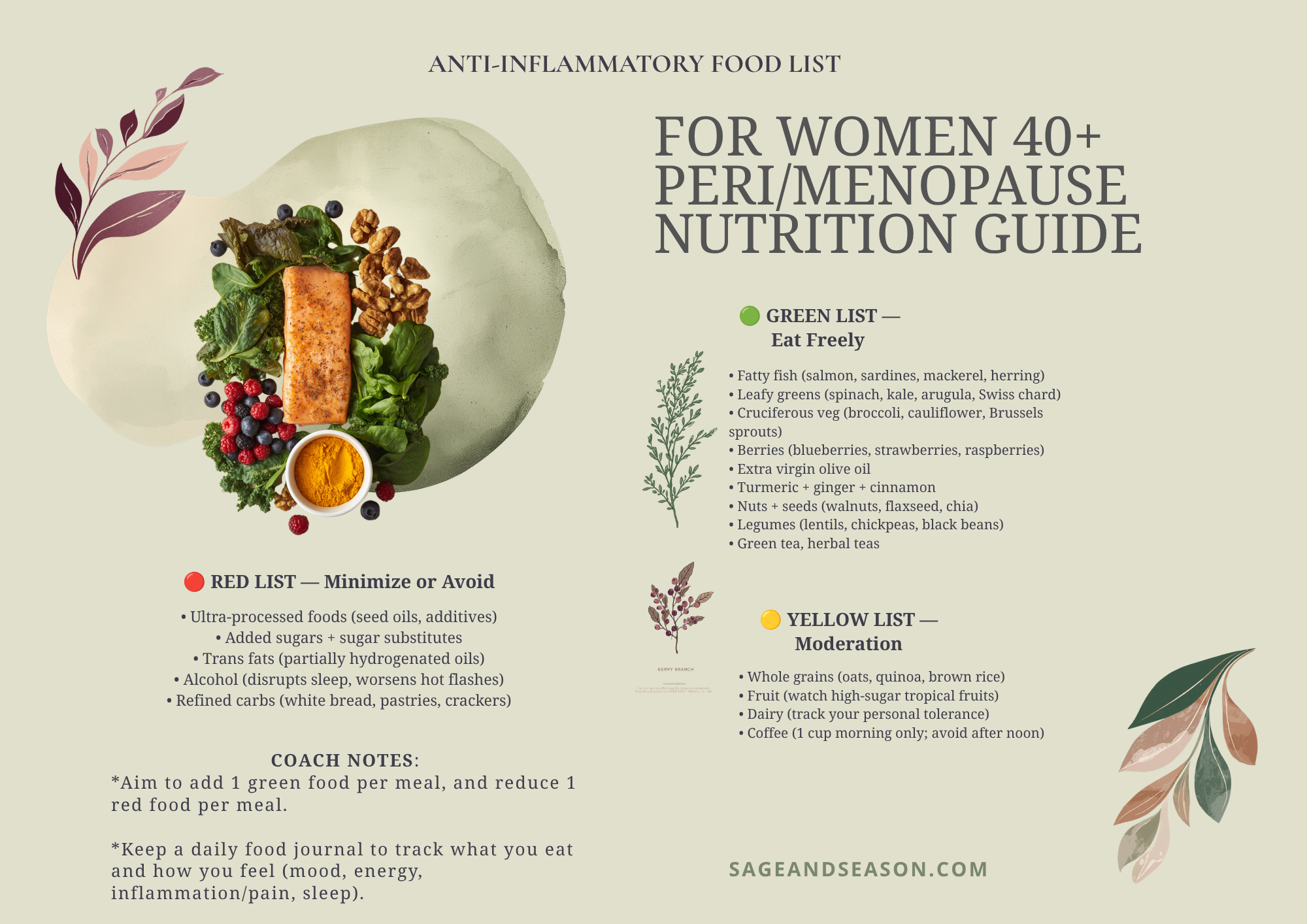
Nutrition After Menopause:
How Food Affects Your Symptoms
Menopause changes how your body uses food. The same meals that kept you steady at forty can leave you tired, hungry, and gaining weight in places you never did before. That is not a willpower problem. When estrogen declines, your metabolism, your muscle, your bones, and your blood sugar all start behaving differently, and food is one of the few levers that acts on all of them at once.
Food will not replace the hormones your body has stopped making. What it does is change how loud the symptoms get. The right pattern of eating can steady your energy, protect the muscle and bone you are losing faster now, and take the edge off hot flashes, mood swings, and broken sleep. This page explains why, and what each part of your diet is actually doing.

How Food Influences Menopause Symptoms
Estrogen does more than run your cycle. It helps regulate blood sugar, preserve bone, hold onto muscle, manage where you store fat, and dampen inflammation. As it falls, each of those jobs gets harder, and that shows up as the symptoms you feel day to day.
Blood sugar is the clearest example. As estrogen drops, cells become more resistant to insulin, so the same carbohydrate meal spikes your blood sugar higher and drops it harder. Those swings track closely with more frequent and more severe hot flashes and night sweats, along with the afternoon energy crashes, cravings, and irritability that come with them. Steadying blood sugar is one of the most direct things food can do for how you feel.
So diet helps through a few clear mechanisms. It steadies blood sugar. It supplies the raw materials to defend muscle and bone. It feeds the gut bacteria that help your body process estrogen. And it lowers the background inflammation that rises after menopause. None of this cures menopause, and every woman responds differently. But these are real, measurable effects, not wishful thinking.
Macronutrients and How They Help
Protein
This is the one most women get wrong, because the amount that was fine before is no longer enough. How much protein we need after menopause looks very different than it ever did before. After menopause, muscle loss speeds up, and muscle is what keeps your metabolism running and your body strong and stable. Bone is also part protein, so the same shortfall that costs you muscle weakens the frame underneath it.
Most women do well aiming for roughly 1.0 to 1.2 grams of protein per kilogram of body weight per day. If you are active, lifting weights, or trying to lose weight, experts recommend increasing the target to 1.2 to 1.6 grams of protein per kilogram of body weight per day. Spreading it across meals matters more than hitting the number at dinner, because your body uses it more effectively in moderate amounts throughout the day. Protein also blunts hunger, which makes the weight changes of this stage easier to manage. One honest caveat: protein supports muscle, bone, and appetite. It is not a treatment for hot flashes.
Fiber and the carbohydrates you choose
The goal here is not cutting carbs. It is choosing carbohydrates that come with fiber attached, and getting far more fiber than most women do.
Fiber slows how fast sugar enters your blood, which flattens the spikes and crashes driving your symptoms. It lowers cholesterol at a time when heart risk climbs. It keeps you full. And it feeds the gut bacteria involved in clearing estrogen from your body. The payoff is measurable: women eating at least 25 grams of fiber a day have been found to have a meaningfully lower risk of moderate to severe hot flashes than women eating the least. Refined carbohydrates and added sugar do the opposite, spiking blood sugar and adding to the symptom load.
Fats
Fat is not the enemy here either. Healthy fats support brain function and mood, both of which take a hit during the transition, and they protect the heart as cardiovascular risk rises after menopause. Omega-3 fats in particular help with inflammation and mood. The move is toward quality fats, not away from fat altogether.
Micronutrients That Matter Most
Calcium and vitamin D
Bone loss is fastest in the first years after your final period, which makes this pair non-negotiable. Postmenopausal women are generally advised to reach about 1,200 milligrams of calcium a day, ideally from food first, since the body absorbs it well from meals and food carries other nutrients alongside it. Vitamin D is what lets your body actually use that calcium, so both need to be adequate together. Supplements can fill a genuine gap, but more is not better, and the amount is worth confirming with your doctor rather than guessing.
Magnesium
Magnesium is involved in sleep, muscle function, mood, and hundreds of other processes, and many women find it helpful during a stage when sleep is fragile. The evidence specific to menopause is still limited, so treat it as supportive rather than a fix.
Other nutrients
B vitamins support energy and mood and help regulate a marker tied to heart health. Worth knowing: once periods stop, your iron needs drop sharply, so unless a doctor has told you otherwise, this is usually not the time to be supplementing iron.
Phytoestrogens and soy
Phytoestrogens are plant compounds, most notably the isoflavones in soy, that weakly mimic estrogen in the body. The evidence that they ease hot flashes is modest and mixed. Some women get real relief, others notice nothing, and researchers are still sorting out why. Soy foods carry other benefits regardless, including better cholesterol. If you have a history of breast cancer or are at elevated risk, the soy question is genuinely nuanced and belongs in a conversation with your doctor.
Which Foods Tend To Make Symptoms Worse
A few things reliably add to the load. Added sugar and refined carbohydrates drive the blood sugar swings behind hot flashes and energy crashes. Alcohol disrupts sleep, can trigger hot flashes, and works against bone. Too much caffeine frays already fragile sleep. And crash dieting backfires hard here, stripping the muscle and bone you are trying to protect and slowing the metabolism you are trying to support.
The Pattern Matters More Than Any Single Food
No one food fixes menopause, and you do not need a perfect diet. A steady pattern built on whole foods, plenty of plants and fiber, enough protein, and quality fats, close to a Mediterranean way of eating, is what moves symptoms in the right direction. Consistency beats perfection every time.
What that looks like on your plate depends on your body, your history, and your life, and that is where coaching comes in. This is guidance, not a prescription. If you are managing medical symptoms or have an existing condition, I work alongside your doctor, never in place of them.
coaching packages
Work With Me...
You've been told your labs are normal. You've been told to lose weight, sleep more, stress less, and then sent home. You know something is off, and you're tired of explaining it to people who don't listen.
I've been where you are. I know you're not crazy.
What I teach isn't another overhaul that falls apart by week three. It's small, sustainable changes you can start the day you learn them, built around the four things your body actually runs on: how you nourish it, how you move, how you rest, and how you handle stress. And you won't do it alone. You'll have a private community of women walking the same road right beside you.
Here are three ways to work together. Pick the one that fits where you are right now.
Self Study
For the woman who wants to start today, at her own pace. A step-by-step program you move through on your own schedule, using the same simple changes I made myself. Everything is designed to be doable from day one. No overwhelm, no all-or-nothing rules. Start whenever you're ready.
Group Consulting
Learn alongside a small group of women who get it. You get a live group session (60 minutes) plus access to my private Facebook community, where you can ask questions, share wins, and finally be heard between calls. It's real support and real accountability, without the one-on-one price.
One-on-One Consulting
My most personal option. We work together directly to build a plan around your body, your history, and your life. You get my full attention and a woman in your corner who has actually been through it, not a script. This is for you if you're done piecing it together alone and want a real guide.
More About Nutrition
Blood Sugar and Menopause: Why It Spikes and How to Steady It
If your energy crashes every afternoon, your cravings have gotten louder, or the weight around your middle will not shift, your blood sugar may be part of the story. Estrogen helps your body keep blood sugar steady. As it declines through perimenopause and menopause,...
Protein Needs After Menopause: How Much and Why
Most women eat too little protein for the body they now have. The standard recommendation, 0.8 grams per kilogram of body weight, was set as a minimum to prevent deficiency in the general adult population. It was never meant to be the optimal target for a menopausal...
References
- “How much protein do you really need after menopause?” Mayo Clinic Press, 2024. Link Supports the 1.0–1.2 g/kg protein figure. Reputable institutional source; not primary literature.
- Taku K, Melby MK, Kronenberg F, Kurzer MS, Messina M. “Extracted or synthesized soybean isoflavones reduce menopausal hot flash frequency and severity: systematic review and meta-analysis of randomized controlled trials.” Menopause, 2012;19(7):776–790. PubMed Peer-reviewed primary source. Supports the ~20.6% frequency and ~26.2% severity reduction in hot flashes from soy isoflavones.
- “How much calcium do you really need?” Harvard Health Publishing, 2026. Link Supports the 1,200 mg/day calcium recommendation for women over 50, set by the National Academies (formerly Institute of Medicine).
- “Calcium and Vitamin D Supplementation with and Without Collagen on Bone Density and Skin Elasticity in Menopausal Women: A Randomized Controlled Study.” NCBI / PMC, 2024. Link Peer-reviewed. Confirms 1,200 mg/day calcium as the recommendation for most postmenopausal women and the role of vitamin D in absorption.